
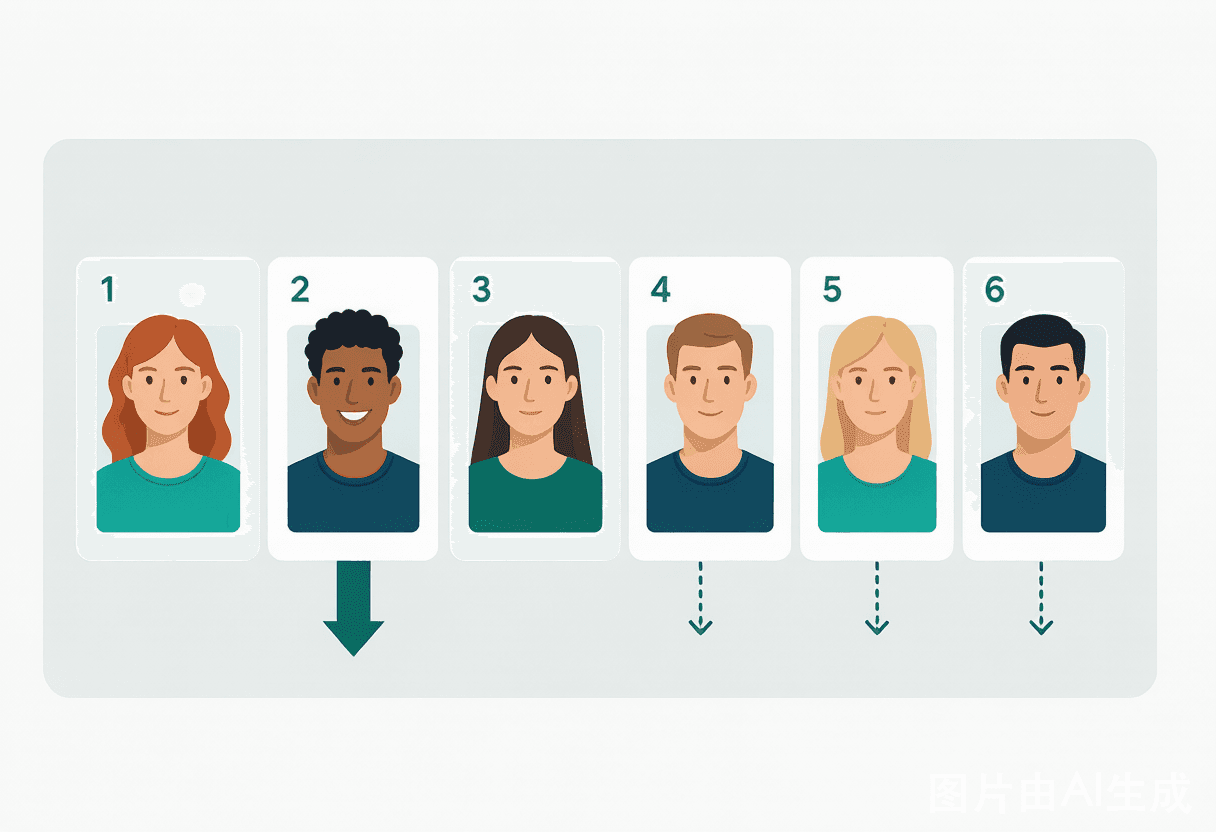
Dating Photo Order: How to Sequence Your Photos for More Matches
Table of contents
- Why dating photo order matters
- The job of each photo slot
- How order changes across Tinder, Hinge, and Bumble
- Common dating photo order mistakes
- How to order your photos step by step
- FAQ
Dating photo order is one of the highest-leverage and most overlooked levers on a dating profile. The same five photos in two different orders can produce very different match rates, because every dating app weighs the early photos far more heavily than the later ones. This guide breaks down why order matters, what each slot should do, how order shifts across Tinder, Hinge, and Bumble, and how to sequence your own photos without guessing.
Why dating photo order matters
On a dating app, attention collapses fast. A viewer spends roughly a second on your lead photo before deciding to keep scrolling or move on, and most decisions are made before they ever reach the last photo in your lineup. That means the front of your lineup carries almost all of the weight, and the back of your lineup matters only if the front earns enough attention to get there.
Order matters for a second, less obvious reason: each photo is read relative to the one before it. A full-body photo in slot two confirms what the lead photo promised; the same photo in slot one can read as too much too soon. A group photo in slot three signals social proof; the same photo in slot one makes a viewer guess who you are and usually swipe left. The order is the context that gives each photo its meaning.
This is why a strong set of photos in the wrong order can underperform a weaker set in the right order. The goal of ordering is not to show your best photos first — it is to build a sequence that earns attention, builds trust, and rewards the viewer for scrolling.
Want AI to choose your best photo? Analyze your photos free and get a per-photo ranking in seconds.
The job of each photo slot
A strong dating photo set is not a random collection of good photos. It is a sequence in which each slot does a specific job. Here is what each slot should do, and what to put there.
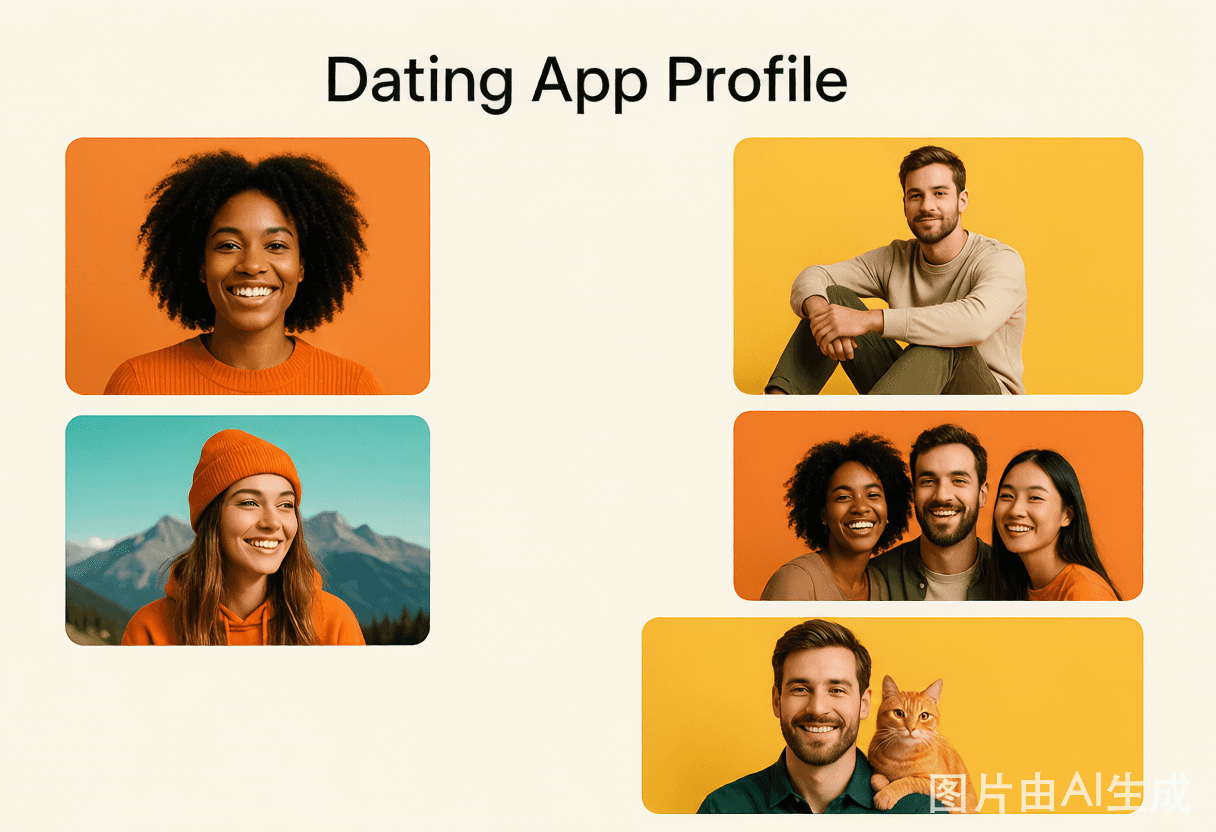
Slot 1 — the lead photo. This is the photo that earns the swipe or the first message. It should be a clear, well-lit solo shot with your face and eyes visible and an approachable expression. No sunglasses, no group, no distance shots. If you get only one photo right, get this one right — it carries more weight than every other photo combined.
Slot 2 — the confirmation photo. A second solo shot from a different angle or setting. Its job is to confirm that the lead photo was honest and to give the viewer a second look at you. A full-body photo often works well here, because it gives context the lead photo could not.
Slot 3 — the context photo. This is where an activity, hobby, or social photo belongs. It gives a viewer something to talk about, especially on Hinge where photos pair with prompts. A photo of you doing something you enjoy reads as more interesting than a fourth selfie.
Slot 4 — the personality photo. A pet, a travel moment, or a candid that makes you feel like a real person rather than a lineup of poses. This is the slot where a specific detail can turn a maybe into a message.
Slot 5 and beyond — supporting photos. Additional photos should each add new information. Once you are repeating angles, outfits, or settings, you are diluting the set rather than strengthening it. Four to six photos is the sweet spot; beyond six, quality almost always drops.
How order changes across Tinder, Hinge, and Bumble
The same set of photos should be ordered slightly differently on each app, because each app shows and weighs photos differently.
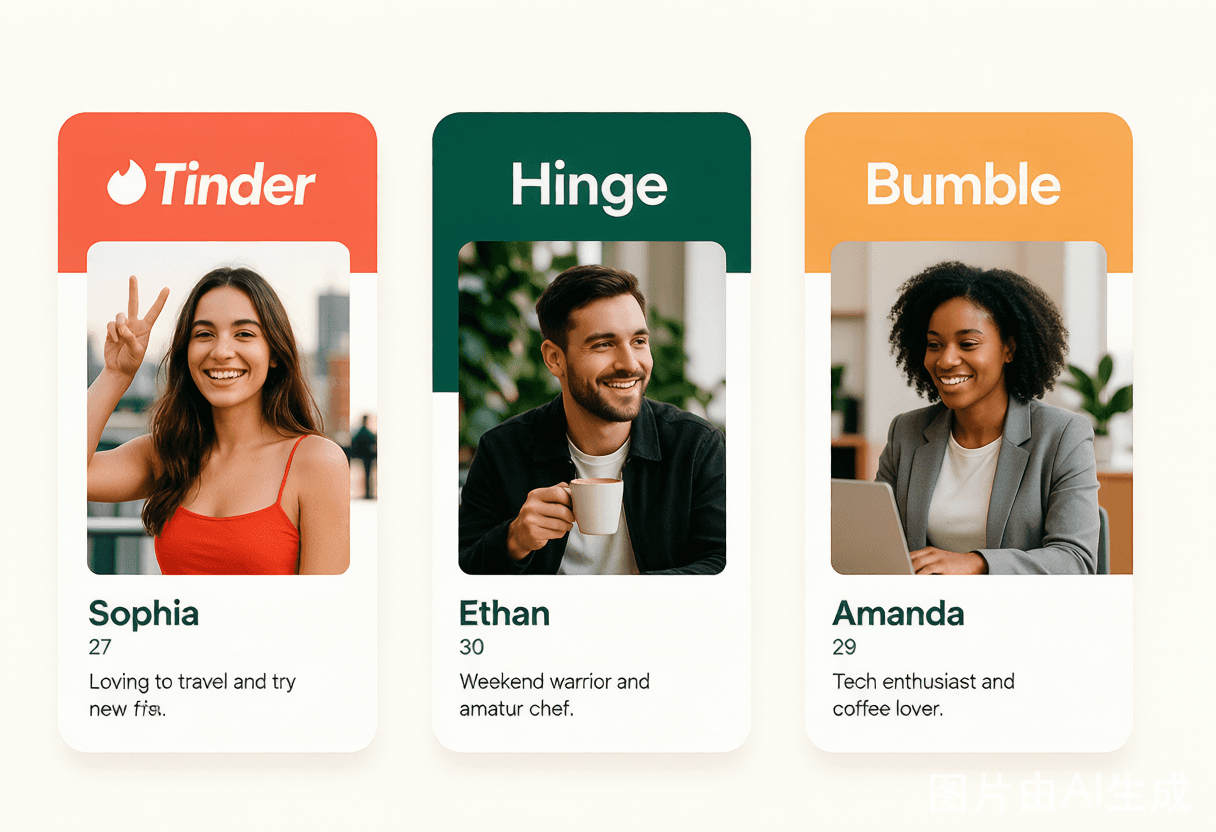
Tinder leads with a single swipeable photo shown full-size in the deck. The lead photo carries almost all of the weight, because most swipe decisions happen before a viewer scrolls to photo two. Order your Tinder photos with your single strongest, clearest solo shot first, and make sure every photo after it is strong enough that a viewer who scrolls is rewarded rather than disappointed.
Hinge shows photos in a grid paired with prompts, which changes the math. The lead photo still matters most, but photos two and three get far more attention than they do on Tinder, because they sit next to prompts a viewer is already reading. Order your Hinge photos so that slots two and three are photos that invite comments — an activity, a hobby, or a photo with a clear story behind it. See our Hinge photo analysis guide for a platform-specific review of which of your photos should lead and fill the Hinge grid.
Bumble is the major app where women message first, which raises the bar on how approachable your lead photo looks. A warm, approachable lead photo earns more first messages on Bumble than an intense or serious one. Order your Bumble photos with approachability as the top priority for the lead, then sequence the rest the same way you would on Tinder.
The practical takeaway: build one strong set of photos, then reorder the lead and the early slots per app based on what each platform rewards. You do not need five different photo sets — you need one good set ordered differently.
Common dating photo order mistakes
Most dating photo order problems fall into a small number of patterns. If your match rate is lower than you expect, check for these.
- Leading with a group photo. A group photo in slot one makes a viewer guess who you are, and most will not bother — they swipe left. Always lead with a clear solo shot.
- Leading with a photo that hides your face. Sunglasses, a hat pulled low, or a distant shot all weaken the trust signal a lead photo needs to send. The lead photo should show your face and eyes clearly.
- Putting your weakest photo in slot two. Slot two is the confirmation photo. If it is blurry, outdated, or a mirror selfie, a viewer who scrolled past a strong lead photo loses trust and bounces.
- Repeating the same angle or setting. Four selfies from the same angle read as thin even if each one is fine. Each photo should add new information — a different angle, a different setting, a different mood.
- Hiding your best photo in slot five. If your clearest, most approachable solo shot is sitting in the back of the lineup, almost no one will see it. Move it to slot one.
- Keeping a photo that is actively hurting you. A blurry, heavily filtered, or outdated photo reduces matches just by sitting in the lineup. Cut it rather than leaving it in to fill a slot.
If any of these patterns sound familiar, the fix is rarely to take new photos — it is to reorder and cut. Most people already have a stronger lineup buried inside a weaker one.
How to order your photos step by step
Ordering your photos is a small, concrete project. Here is the process.
- Gather every candidate photo. Pull 10 to 15 current photos — solo, full-body, activity, and social. Do not include outdated shots; they hurt more than they help.
- Cut the ones that are actively hurting you. Remove blurry, low-resolution, heavily filtered, outdated, and mirror-selfie photos first. These reduce matches just by being in the lineup.
- Pick your lead photo. Choose the clearest solo shot with visible eyes and an approachable expression. This is the photo that earns the swipe, so spend the most time here.
- Order the rest by what they add. Slot two confirms, slot three gives context, slot four adds personality. Each photo should add information the previous one did not.
- Cut anything that repeats. Once you have a photo that does each job, do not add a second photo that does the same job. Four strong photos beat six repetitive ones.
- Tailor the lead per app. Lead with clarity on Tinder, with conversation potential on Hinge, with approachability on Bumble.
If you get stuck on step 3 or 4, that is exactly where a photo analysis helps. ProfileFixAI reads each photo across the signals a viewer actually uses — clarity, face visibility, expression, composition, lighting, background, trust signals, and photo variety — then ranks them and tells you which should lead, which to cut, and how to order the rest. It turns a guessing game into a ranked list tied to your specific photos, and it is the fastest way to find the order your photos deserve.
Want AI to order your photos?
Not sure what order your photos should be in? ProfileFixAI ranks every photo you upload into the right order for Tinder, Hinge, or Bumble — lead photo, middle, and what to cut. Get your photo order → or use the Dating Profile Photo Analyzer to upload 3–10 photos and get a full ranking.
FAQ
Does photo order really matter on dating apps?
Yes. On Tinder the first photo decides most swipes, on Hinge the grid order shapes which photos get comments, and on Bumble the lead photo shapes whether you get a first message. The same set in a different order performs differently.
What photo should be first on a dating profile?
A clear, well-lit solo shot with your face and eyes visible and an approachable expression. It should be the single photo you are most confident in, because it earns the swipe or first message that every later photo depends on.
How many photos should I put on my dating profile?
Four to six. Fewer reads as thin and lowers trust; more dilutes quality and makes viewers scroll past. Every photo should add information the previous ones did not.
Should I put a group photo in my dating profile?
Yes, but only one, and never first. A group photo signals social proof, but if a viewer has to guess who you are, they usually swipe left. Keep it in slot two or three.
Can AI help me order my dating photos?
Yes. ProfileFixAI reads each photo across clarity, face visibility, expression, composition, lighting, background, and trust signals, then ranks them and tells you which should lead, which to cut, and how to order the rest.
FAQ
Does photo order really matter on dating apps?
Yes. On Tinder the first photo decides most swipes, on Hinge the grid order shapes which photos get comments, and on Bumble the lead photo shapes whether you get a first message. The same set in a different order performs differently.
What photo should be first on a dating profile?
A clear, well-lit solo shot with your face and eyes visible and an approachable expression. It should be the single photo you are most confident in, because it earns the swipe or first message that every later photo depends on.
How many photos should I put on my dating profile?
Four to six. Fewer reads as thin and lowers trust; more dilutes quality and makes viewers scroll past. Every photo should add information the previous ones did not.
Should I put a group photo in my dating profile?
Yes, but only one, and never first. A group photo signals social proof, but if a viewer has to guess who you are, they usually swipe left. Keep it in slot two or three.
Can AI help me order my dating photos?
Yes. ProfileFixAI reads each photo across clarity, face visibility, expression, composition, lighting, background, and trust signals, then ranks them and tells you which should lead, which to cut, and how to order the rest.
Want AI to choose your best photo?
Upload your photos and get a photo-by-photo ranking and fix list for free.
Analyze Your Photos Free